Meditations on the Creation of Universo Mistral.
“You shall create beauty not to excite the senses but to give sustenance to the soul.”
Yesterday was the premiere of my latest dance piece, a solo created for the Brazilian dancer Zilda Arali. The project, winner of the Nelson Seixas Prize, pays tribute to the Chilean poet who won the Nobel Prize for Literature in 1945.
This project is very special to me because it was developed in my hometown, São José do Rio Preto. I traveled there this summer (winter in Brazil), and we had three weeks to find, in the dancing body, the poetry of Gabriela Mistral. My family did not expect me to be there—I arrived by surprise. They were overjoyed yet confused, and these overwhelming sensations shaped the journey of my creative process.
The research for this work began in Austria, where I live, and it was an incredible experience to immerse myself in Mistral’s work. I was fully prepared with images I wanted to translate into dance movements and ideas to connect with the audience in the same way Gabriela Mistral’s words had touched me. However, reality turned out to be completely different from my imagination.
For two summers, I had not visited my country. I had been immersed in a different reality—working in a great theater, feeling the stress of each premiere, under pressure from both my own ambitions and the expectations of others. Returning to my roots, these contrasting realities collided, making it difficult to find myself again for a while.
Crossing temporalities and realities became the key to deeply understanding Gabriela Mistral’s experience of living as a foreigner, as “the other.” This became a creative force—transforming art and education through the work.
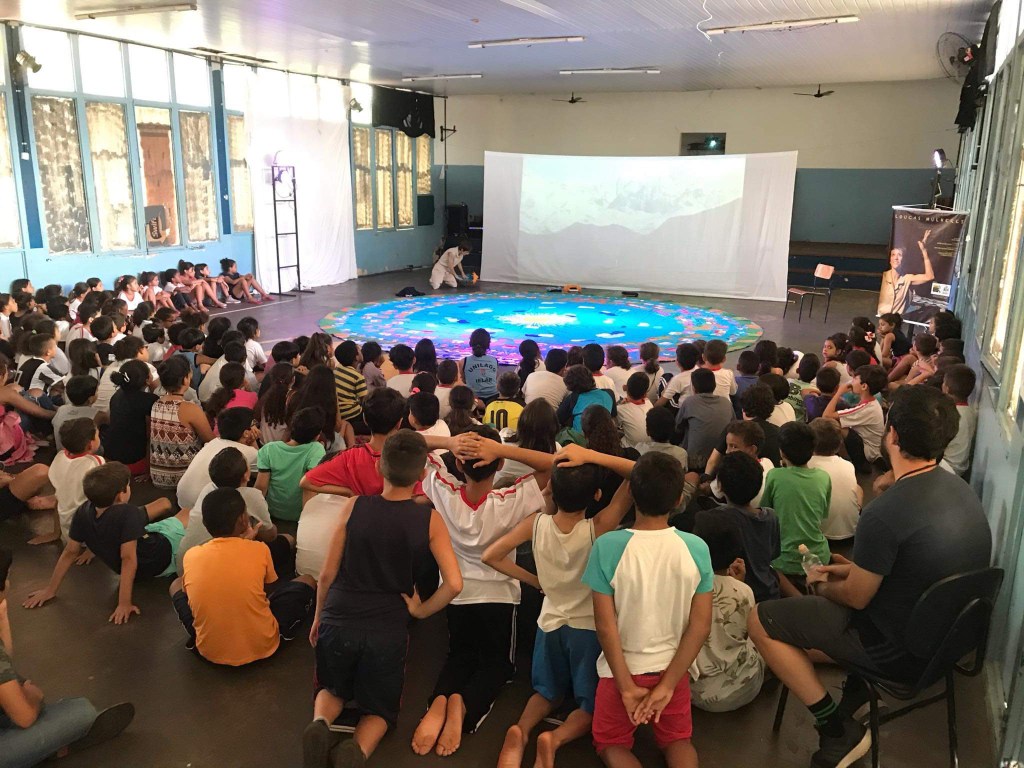
When I received the pictures from our preview, I was deeply moved. I owe my twenty-three-year dance career to projects like this. I am grateful that today, I can return and share what I have learned.
I deeply experienced how the incorporation of environment and culture shapes our behavior and our perception of the “stage.” Additionally, I was reminded of the importance of knowing your audience—who you are speaking to. Some choreographers can embrace universal themes and reach diverse audiences. Dance is a universal language, but when it comes to education, pedagogical skills become tools for shaping the imagination in ways that enhance the audience’s ability to appreciate the art of dance.
After this experience, I believe even more in dance as a tool for social transformation. Before creating a dance, many aspects of life—environmental, cultural, personal, and political—are reevaluated within the choreographer’s inner landscape and in relation to the outside world. Dance becomes the meeting point for all these questions and desires, speaking through a subtle yet profound channel. To echo Gabriela Mistral’s words at the opening of this blog: choreographers create beautiful dances not only to excite the senses but to nourish the soul.
I extend my heartfelt thanks to the wonderful team that made this project possible: the incredible dancer Zilda Arali for her passion and commitment, Marcelo Zamora for his organization, mentorship, and production, Jonatan Salgado Romero for bringing our landscapes to the screen, and musicians and composers César de Medeiros and Leandro Doliri for weaving the piece together with their sound design and inspiring music.https://www.diariodaregiao.com.br/_conteudo/2019/10/cultura/1170173-loucas-mulheres-homenageia-a-escritora-chilena-gabriela-mistral.html

 Andressa Miyazato